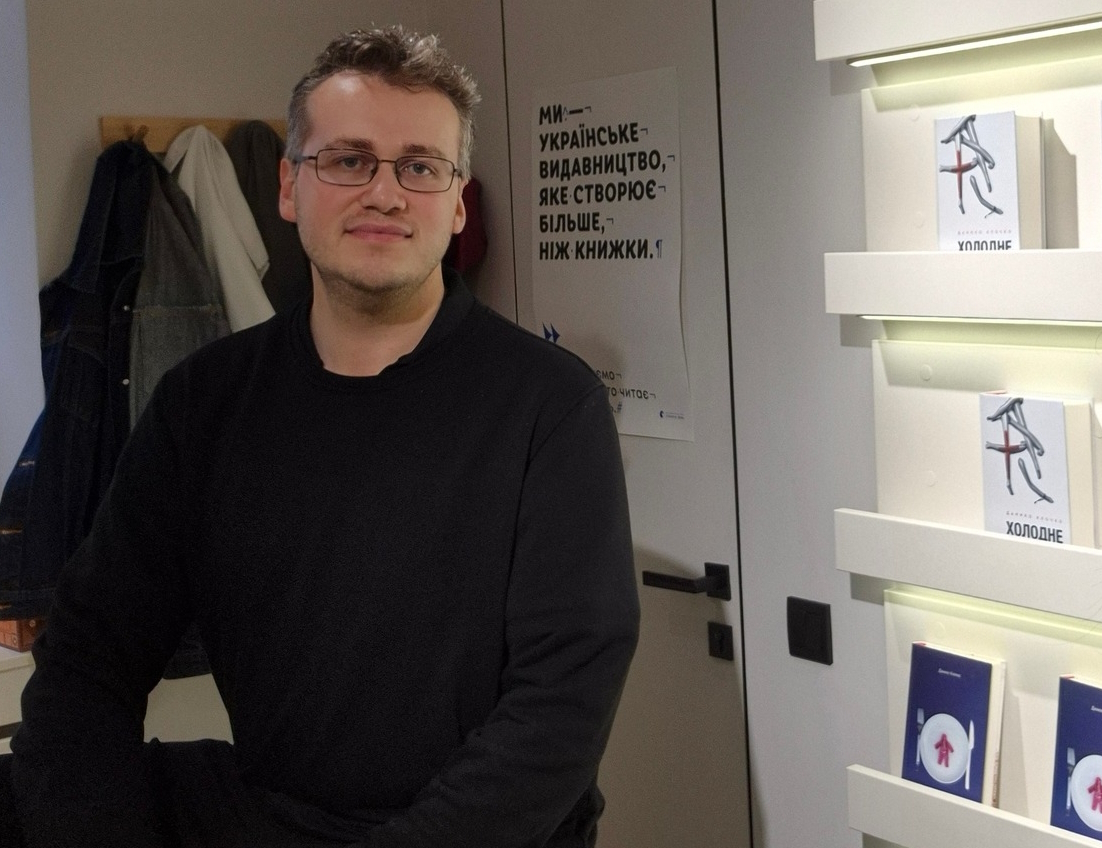
He teaches cultural history at one of Ukraine's most prestigious universities, excavates archaeological sites for a living, and writes science fiction and psychological thrillers in his remaining hours. For Danylo Klochko, these three lives are not separate — they feed each other in ways that are difficult to explain and impossible to untangle.
Danylo Klochko is a Ukrainian writer, archaeologist, and PhD in philosophy who teaches at the Kyiv-Mohyla Academy, one of Ukraine's oldest and most respected universities. His fiction career has developed in parallel with his academic work, and the two inform each other in ways that are immediately visible on the page: his novels carry the precision of someone trained to read what the earth has buried, and the imagination of someone who spends his professional life reconstructing worlds that no longer exist.
His debut novel "Kholodne" — Cold — was published in 2022 by Vydavnytstvo Staroho Leva, one of Ukraine's leading independent publishers. The book is a psychological thriller that established Klochko's voice: controlled, atmospheric, attentive to the texture of place and the weight of silence. His second novel "Mohyly Tsariv" — The Tombs of Kings — followed in 2025, moving into science fiction territory while retaining the psychological density of his debut. Both books appeared at a moment when Ukrainian literature was undergoing an extraordinary transformation — becoming more visible internationally, more urgent domestically, and more willing to inhabit genres that had previously been considered peripheral.
"Archaeology teaches you to be patient with what is hidden. Fiction teaches you to be brave enough to imagine it."
The connection between Klochko's archaeological practice and his fiction is not merely thematic — it is methodological. Archaeology is fundamentally an act of reconstruction: you find fragments, you read context, and you build a picture of something that is no longer present. Fiction does the same thing, but in reverse — you start with an imagined whole and work backward toward the fragments that will make it feel real. Klochko moves between these two directions with the ease of someone who has spent years in both.
His third novel — currently in progress — continues in the science fiction direction, and represents an expansion of the thematic territory he began exploring in "The Tombs of Kings." In an era when Ukrainian writers are being read and translated with unprecedented attention, Klochko's work occupies an interesting position: genre fiction written with the care and seriousness of literary prose, rooted in a deep engagement with Ukrainian history and landscape, and carrying within it the particular urgency of a writer who lives and works in a country at war.
For Klochko, the question of what Ukrainian science fiction can be — what futures it is permitted to imagine, what pasts it needs to reckon with — is not abstract. It is something he engages with through every novel he writes, every lecture he gives, and every site he excavates. The buried cities and forgotten kings that his archaeological work uncovers are not simply historical objects. They are the raw material of a national imagination that is, right now, in the process of remaking itself.