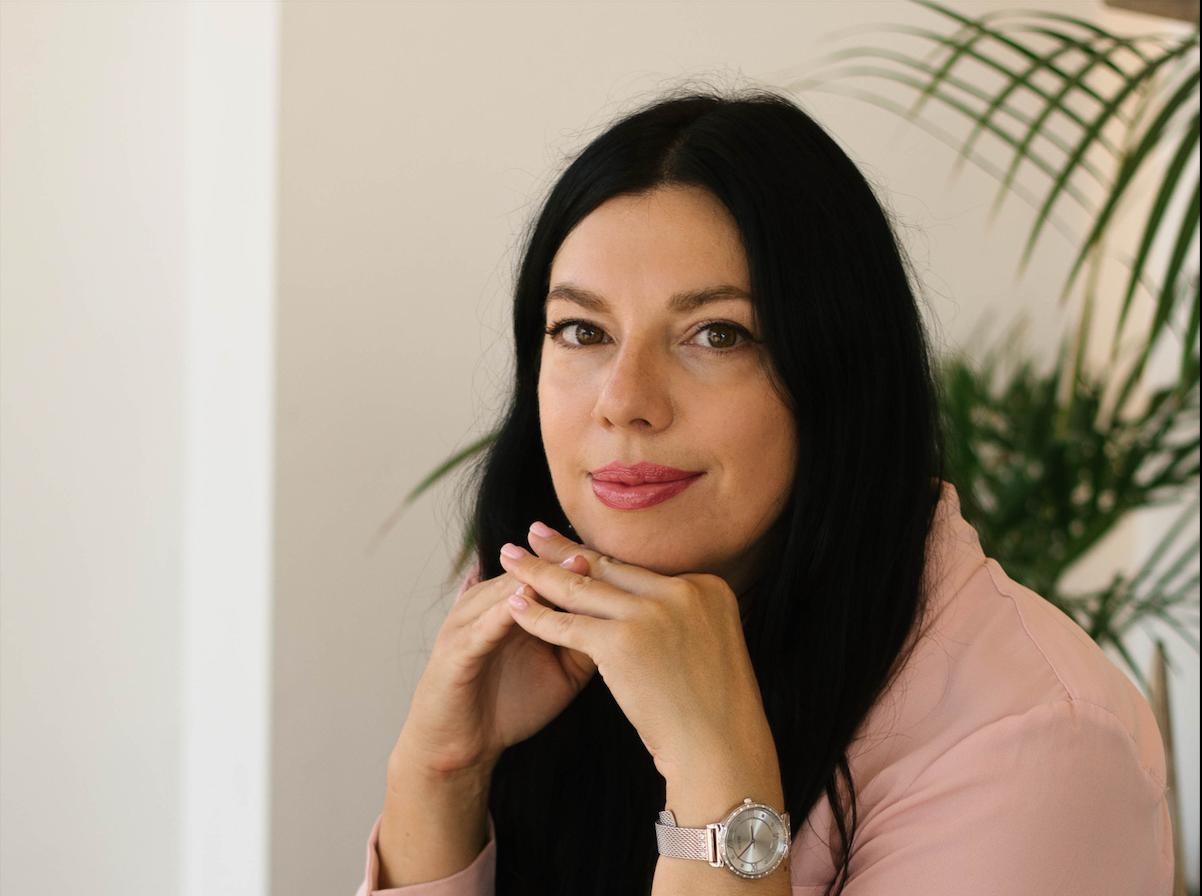
War forced her to leave Ukraine, and in Sofia she picked up the brush again — this time in oil. Painter Julia Sukho talks about the garden of her childhood, the philosophy she calls Aliveness, and why her flowers are not decoration but proof that life keeps winning.
Julia Sukho, born Julia Sukhorukova, was born in Chernihiv, but her childhood years were spent on an estate outside Kyiv — among trees and flowers, in a garden where her great-grandfather grew selectively bred varieties of plants and fruit trees, and her great-grandmother grew lush roses once ordered for the actors of a theatre on Andriivskyi Uzvoz. At fifteen, during months of forced bed rest, she picked up a paintbrush for the first time. Her grandfather, who understood fine art, was beside her, showing her how line and paint bring paper to life. For several years she painted portraits, searching faces for what lay hidden beneath them, and studied the history of painting.
She holds a master's degree in pedagogy and philology and is fluent in English and German. She is also a published author of fiction and a winner of literary competitions. For years she travelled between the museums of Germany, France, the Netherlands, Italy and Spain, standing for hours in front of the work of the great masters. Then the war forced her to leave Ukraine. In Sofia, she returned to painting — this time in oil.
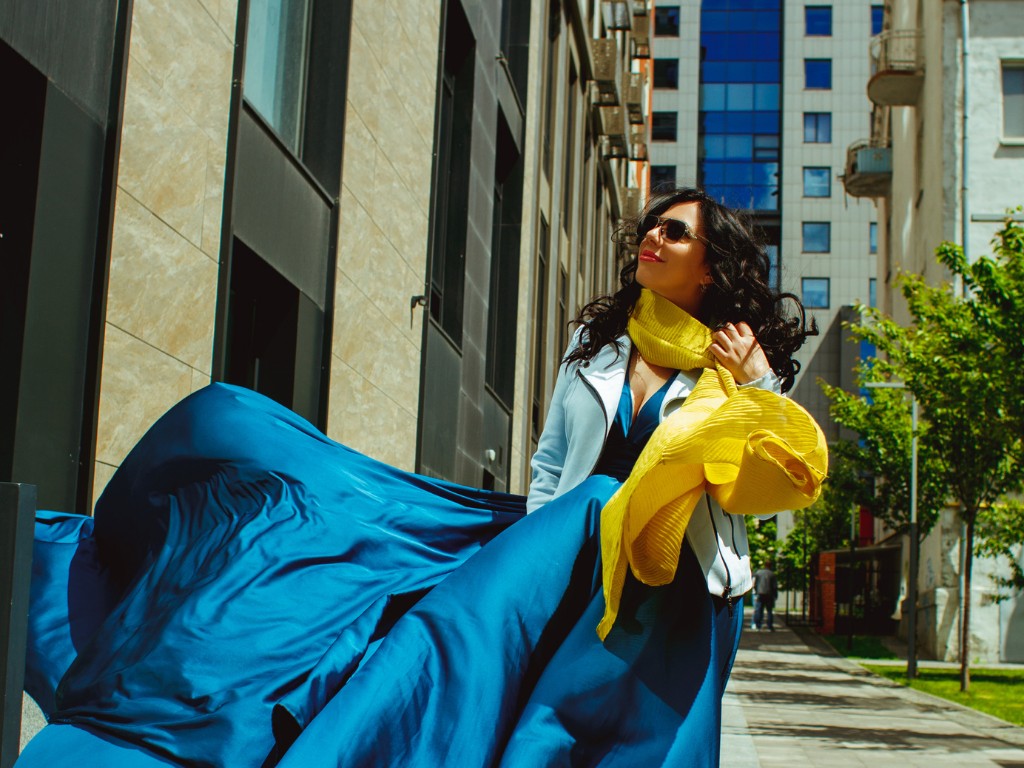
"When the familiar world shook, I found my footing in what always remains alive — a flower, a bumblebee, the light on a petal. This is a beauty that doesn't ask permission to exist."
The garden and nature, she says, are not simply the subject of her paintings — they are the place she comes from, the place she returns to every time she picks up a brush. As a child she spent whole days there, learning every corner, every path, every shadow beneath the apple tree. The more closely she looked, the more life she found in it — astonishing, real life. Every flower had a character; every bumblebee or dragonfly had its own story. She didn't just look at the garden, she read it like a book, listened to it, watched the life stirring inside it. It stirred her imagination with a riot of colour, calmed her with fifty shades of green, rewarded her with sweet raspberries straight from the bush and juicy plums, treated her to apples with honey on the feast of the Transfiguration, filled her varenyky with cherries she had picked herself. The garden bloomed with cream and red roses, white mallows, marigolds like small flames. Beyond the old wooden fence began a field — red poppies, golden wheat, cornflowers swaying in the wind.
She believes many people know this feeling — the feeling of home, of being able, even for a moment, to feel truly alive. These stories, tender and sensory in one canvas, fiery and full of colour, struggle and ambition in another, remain the central theme of her work. It is as if she keeps returning there, again and again — to childhood, to a life that is bound to win, because that victory is built into it by nature itself.
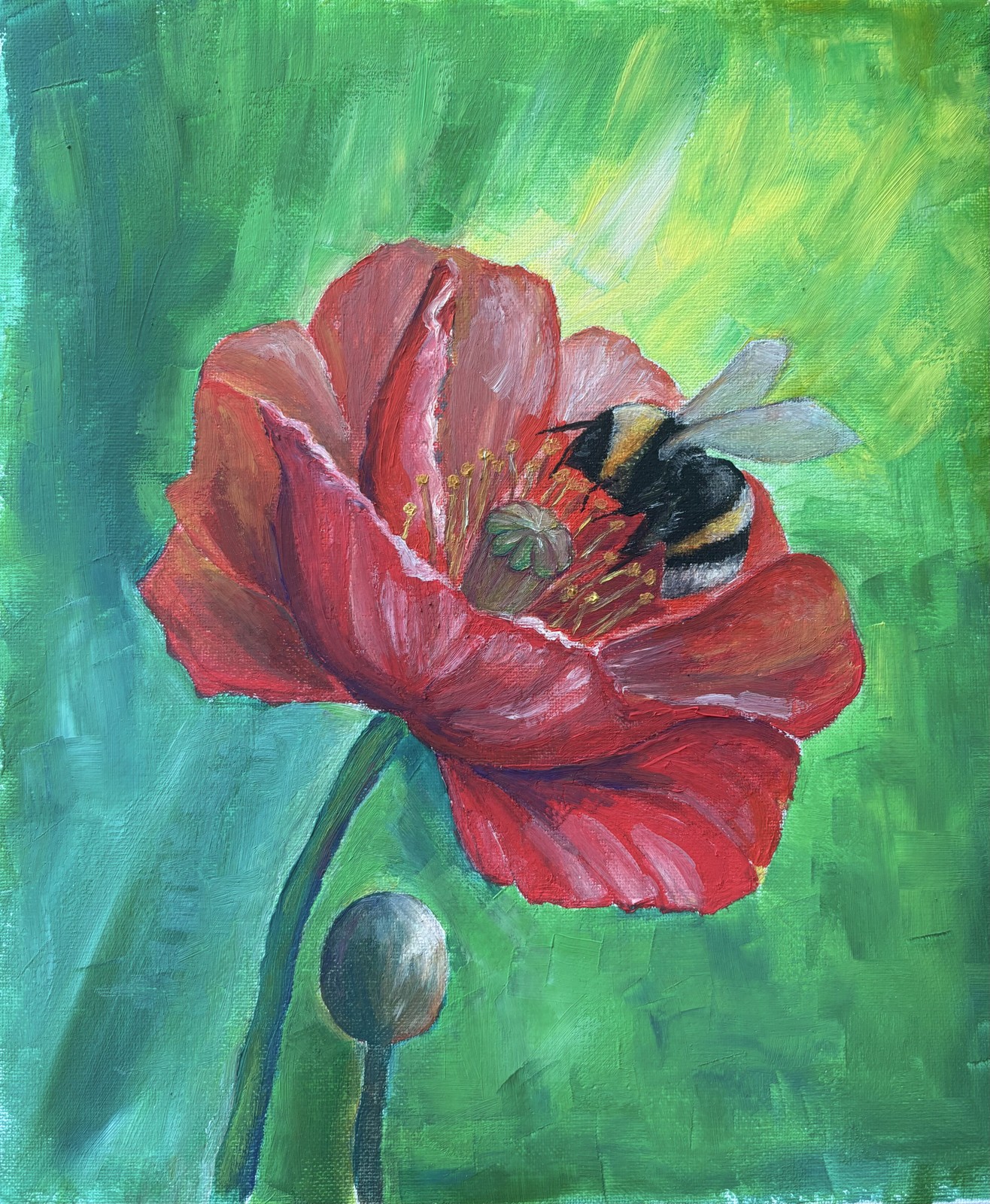
Technically, her work balances between two poles. On one side is impasto — thick, textured brushwork, where the paint sits on the canvas almost sculpturally, holding the trace of the brush's movement; a technique for moments of force, when a flower isn't simply blooming but fighting for its place under the sun, when colour needs to be sculpted rather than painted. On the other side is glazing — thin, transparent layers of paint laid one over another, building the depth of light, the same morning haze on petals, the same coolness she remembers from childhood; a technique for stillness, tenderness, sensuality. Together, these two languages produce what she calls "the secret life of blooming" — botanical motifs in expressive painting, where every work is at once calm, alive, and charged with the inner energy of growth.
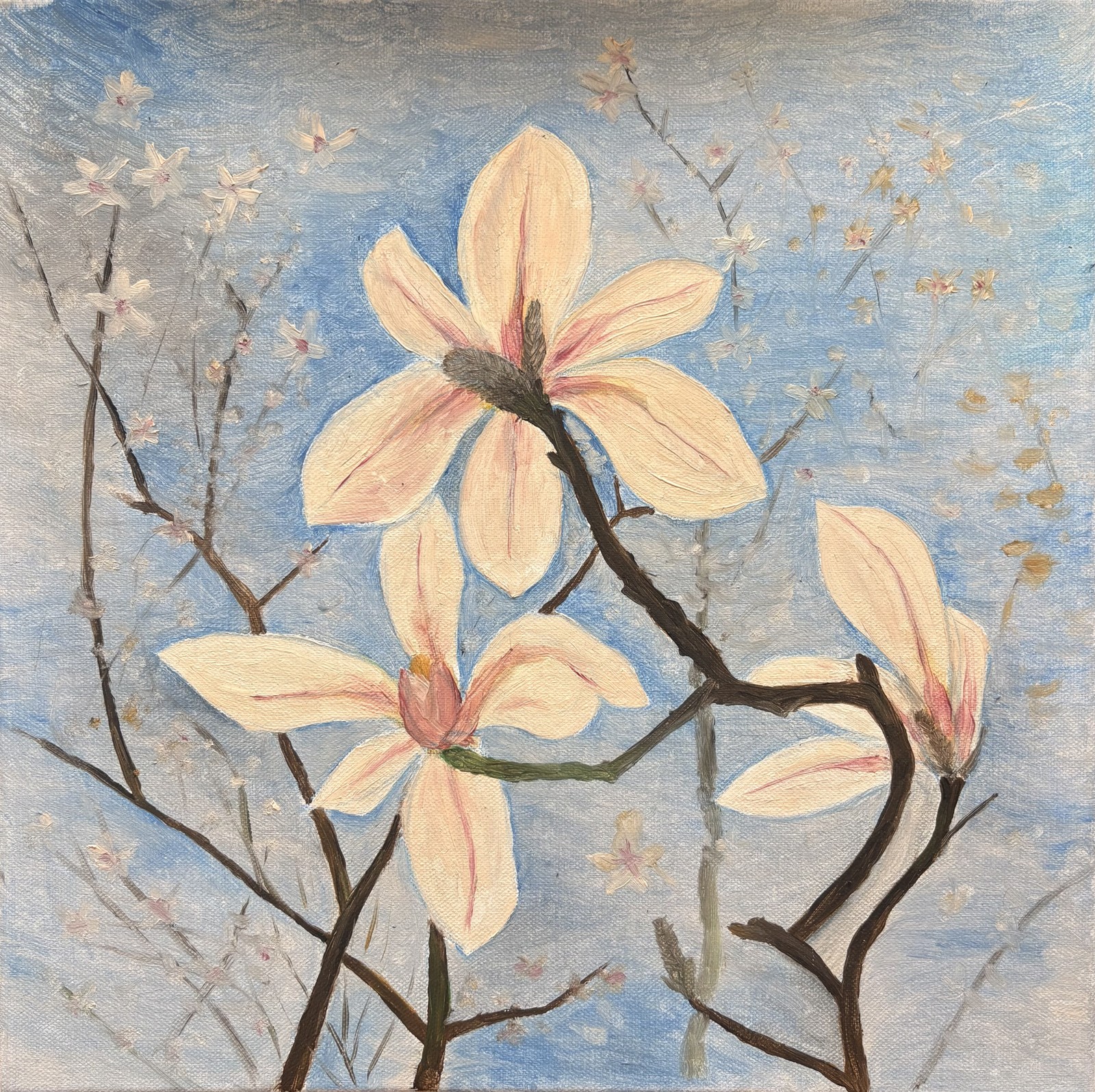
Her work unfolds in series, each one a chapter of the same larger story. The Secret Life of Bloom is about unnoticed heroes — bumblebees, bees, butterflies — whose work goes unseen but without which no flower, no fruit, would exist; a metaphor, she says, for how small, sometimes invisible efforts create a great deal of life. Luminous Light works with the light inside a flower, the moment a petal seems to glow from within — closest to the glazing technique, closest to the morning coolness of her childhood. The Summer Orchard is the warmer, more generous part of the garden — plums, pears, apples — abundance, gratitude, the taste of childhood carried into warm, saturated colour. Together, these series — more than fifteen works — form a living, growing map of her inner world, with every new painting adding another corner to it.
To look at a work by J. Sukho, she says, is to look not simply at a still life or a landscape, but at a preserved moment of real, unembellished life — the kind that keeps blooming even after loss, relocation and separation. It isn't art about perfect beauty; it's about a flower's struggle for sunlight, the character of every petal, the warmth that stays in memory even when home is left far behind. She is still working on the collection, still pushing past the old wooden fence into the field, into the forest, toward the horizon — preparing work for exhibition projects and continuing to tell this story, canvas by canvas.
Original paintings by J. Sukho are available at juliasukho.com and on Etsy. New work is shared live on her Telegram channel, @jullileo.art.