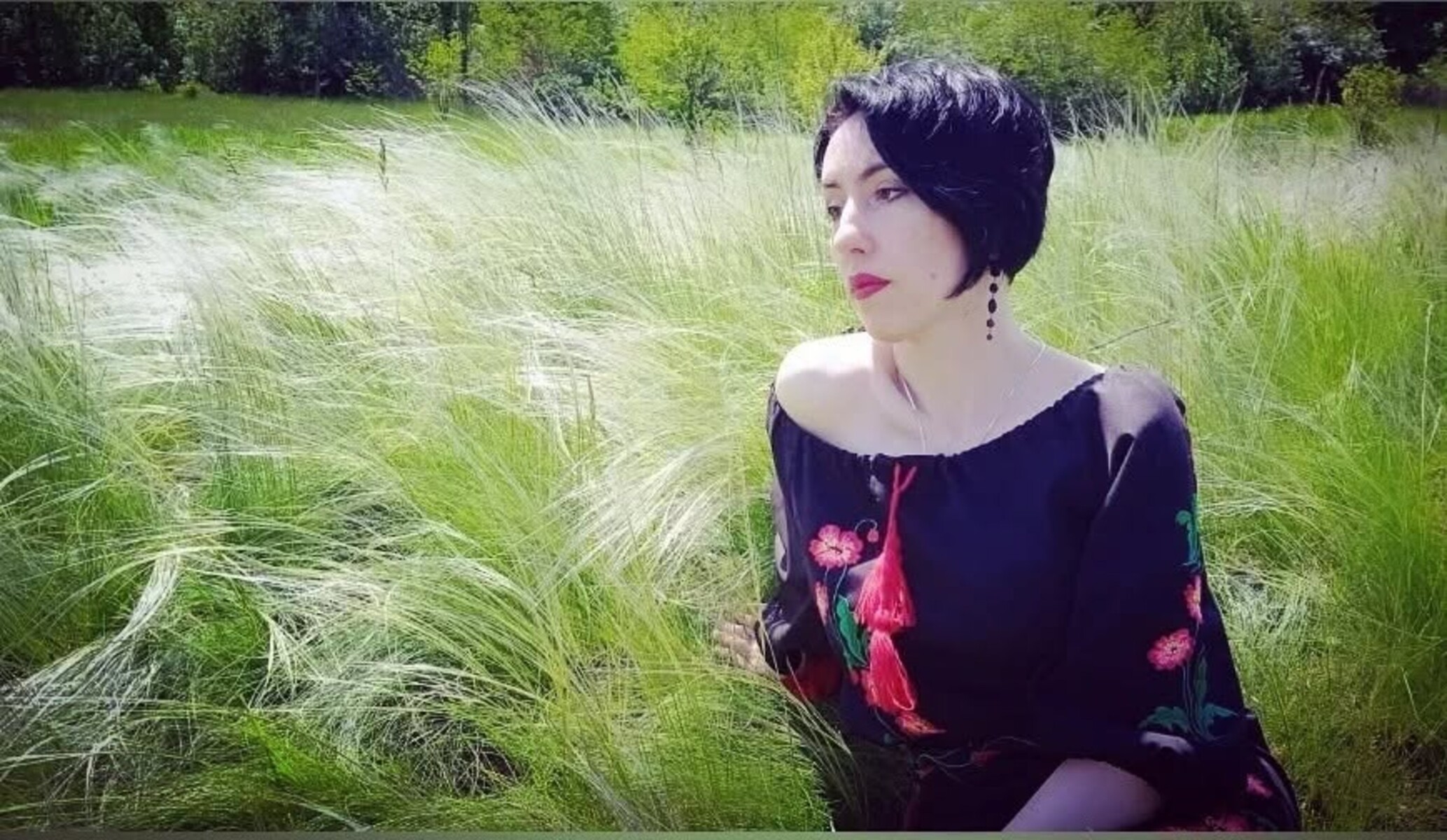
Maya Kliuchova has spent her whole life in Donetsk region, most of it teaching Ukrainian language and literature in a small mining settlement where, for years, Ukrainian-language books were hard to come by at all. She wants the voices of writers from that region — not just Vasyl Stus or Volodymyr Sosiura, but the many lesser-known ones — heard alongside every other Ukrainian voice, in Ukraine and beyond.
Maya Oleksandrivna Kliuchova was born and lived her whole life in Donetsk region, in the small mining settlement of Novodonetske. A teacher of Ukrainian language and literature by profession, she worked for almost 21 years at settlement school No. 17 (now the Novodonetsk hub institution), six of those years also serving as deputy director for educational work. Since 2024 she has lived in Kryvyi Rih, in Dnipropetrovsk region, where she teaches Ukrainian language and literature at the Kryvyi Rih Ternivskyi Lyceum.
She has written poetry since her institute days — more than 25 years now — with experience working on a literary almanac and publishing a small faculty run of her own. She is a participant and winner of numerous literary competitions and festivals at the regional, national and international level, and a member of the All-Ukrainian society "Prosvita," the Congress of Ukrainian Nationalists, and the National Writers' Union of Ukraine. She works to popularize artistic — particularly poetic — creativity among her students and beyond, drawing talented young people into competitions and helping them realize and refine their talents.
Donetsk region, as she describes it, has long been a difficult place for Ukrainian culture: for a long time, Russian language dominated there, and it was hard to find Ukrainian-language books and periodicals at all until a certain point. From her institute years, she sought to spread Ukrainian culture and literature among her students, their parents and the people around her — work made possible by her position as a Ukrainian-language teacher, though limited by the distance from the regional center and larger cultural hubs. After 2014, when the regional cultural center moved from Donetsk to Kramatorsk, she found more chances to take part in events.
In 2016 she took part in the "Kalmius" literary competition, placing third in the "Prose for Children" category. There she met Volodymyr Vakulenko — tortured to death near Izium in 2022 — with whom she had planned to create several children's books together; they only managed to meet once more, at the Volodymyr Sosiura festival in Sloviansk. Vakulenko, she says, understood better than almost anyone the importance of spreading Ukrainian language and culture, since he lived in a Russian-speaking village near Izium, where a pro-Ukrainian position could cost you physically. Her works entered in "Kalmius" were based on real events, written for teenagers about the heroes of the ATO — volunteers, medics, soldiers and civilians who went to fight.
Around that time she also got to know, virtually, the writer and defender Borys Humeniuk; together with one of her students, she wrote a Minor Academy of Sciences research paper on his poetry collection Poems From the War — part of an effort not just to popularize Ukrainian literature generally, but to introduce her students to contemporary Ukrainian writers who had defended the country's sovereignty, since Humeniuk was among those who stood in defense of Donetsk. Since 2014, the range of her own writing has widened to include civic and philosophical lyric poetry, driven by Russia's aggression. Several of her stories from the ATO-heroes cycle were published in the magazine Heroiam Slava, from the "Mamyne Sonechko" publishing house; one story was co-written using material from the well-known volunteer and servicewoman Olena Bilozerska.
"Donbas is territory where the Wild Field once stood — it was what stopped enemy invasions of Ukraine, from Prince Ihor and the Cumans to today. Its history has to be recorded and heard, and entered into the cultural heritage of Ukraine and the world."
Since 2022, her creative work has changed significantly, with the themes of war, loss and Ukraine's defense becoming central — many of her friends and former classmates went to serve, and some of them died; Borys Humeniuk went missing without a trace after returning to defend Ukraine again in 2022. She has shared most of her work through Facebook and Instagram; her own poetry collections have sold in small numbers, though never as many copies as she'd like, and reprinting has been limited by her finances as a single parent. Between 2005 and 2019 she published three of her own poetry collections in print, plus several co-authored ones. She now has a large body of unpublished poems, without the means yet to print them.
She is currently working on assembling a substantial collection of wartime poetry, still being put together — documenting this turbulent period matters, she believes, both for her contemporaries and for future generations. She notes that the literary market is full of war-themed writing already, from soldier-poets like Maksym Kryvtsov to civilians writing about the war — but a survey among her own students showed how little they know of contemporary Ukrainian literature more broadly, and of writers from Donetsk region specifically. Most people, she says, can name only Vasyl Stus or Volodymyr Sosiura as Donetsk-region writers, while few have heard of Oleksiy Chupa, Yuriy Dotsenko and other talented authors from the region. Since 2023 and until her relocation to Dnipropetrovsk region, she served as deputy head of the commission on preserving national culture and identity for the Novodonetske settlement council, organizing meetings with servicemembers, veterans and volunteers, and involving her students in regional cultural events; in 2023 she represented Donetsk region in the "Woman of Donetsk Region" competition, in the "Cultural Achievement of the Year" category.
Among the projects she's currently developing is a poetic-musical collection, combining her poems with the original music that inspired them. Another idea she's carried for a long time is an original creative and therapeutic writing course — first conceived for teenagers with traumatic experiences, though she came to realize, while developing it, that it could serve anyone who struggles to express themselves and wants to understand themselves better through creative writing. The idea took shape long before the war, during her own painful experience of divorce and depression, as she searched for herself and her path; having long worked with words and held an interest in psychology since youth, she built a course meant to use words to work through certain problems — a path she walked herself, with poetry as the ring that pulled her out of a closed circle. The course remains in development and partial testing.
The idea behind the course became even more urgent after the full-scale invasion. In 2022 she evacuated from Donetsk region with her child to Poltava region, witnessing shelling several times along the way — leaving both her and her child with their own traumatic experience. Her home settlement now stands on the edge of disappearing, a trauma in itself, layered onto a war that has already taken friends, close people, and students from her, and left her without a home. The motif of homeland and the steppe recurs often in her poetry; displaced, she says, people like her haven't stopped loving or missing their region. When she left, she took her whole library with her — years of collecting books she couldn't imagine living without.
In Kryvyi Rih, she has been in touch with library and cultural workers, hoping to see a space for creative people established in her own district of the city — Kryvyi Rih is large, and while similar spaces exist elsewhere in it, they're inconvenient to reach often. She'd like to eventually create an art space for musicians, readers, writers, artists and others, maybe something like a bookshop-café, where joint projects could take shape. Last year she took part in the city's poetry marathon "Nескорені" ("Unconquered"), bringing several of her students along — for them, a unique chance to speak about their talent on a big stage and appear in a television segment. More than ten of her students took part in various literary, artistic and academic competitions this year, some as winners, some simply as participants, all wanting to keep developing — and while this future space would serve them too, her deepest wish remains for the voices of Donetsk region to be heard across Ukraine and the world.
She also tries to draw as many students and parents as possible toward reading, largely through her own lessons and personal initiatives, and hopes to collaborate with writer acquaintances, including children's authors, so today's children might choose books over gadgets. One more long-held dream is building a school theatre. In Novodonetske, until 2022, she and her colleagues had built a school puppet theatre — a large project funded through crowdfunding, costing nearly 100,000 hryvnias, with its own sets, puppets and equipment; before quarantine and the war, they staged several performances for kindergartens and used the theatre for school events. With the war, the entire theatre was evacuated along with the rest of the school's property, and she no longer works at that institution — but she hopes to build something similar again, possibly with the help of grant funding.
More on Maya Kliuchova can be found on Facebook.